A hard cover is built as a sequence, not a single act.
Case binding means making the text block and the cover case separately, then joining them with endpapers. It is the familiar hardback structure, but at the bench it is best understood as paper, sewing, spine lining, boards and final attachment.
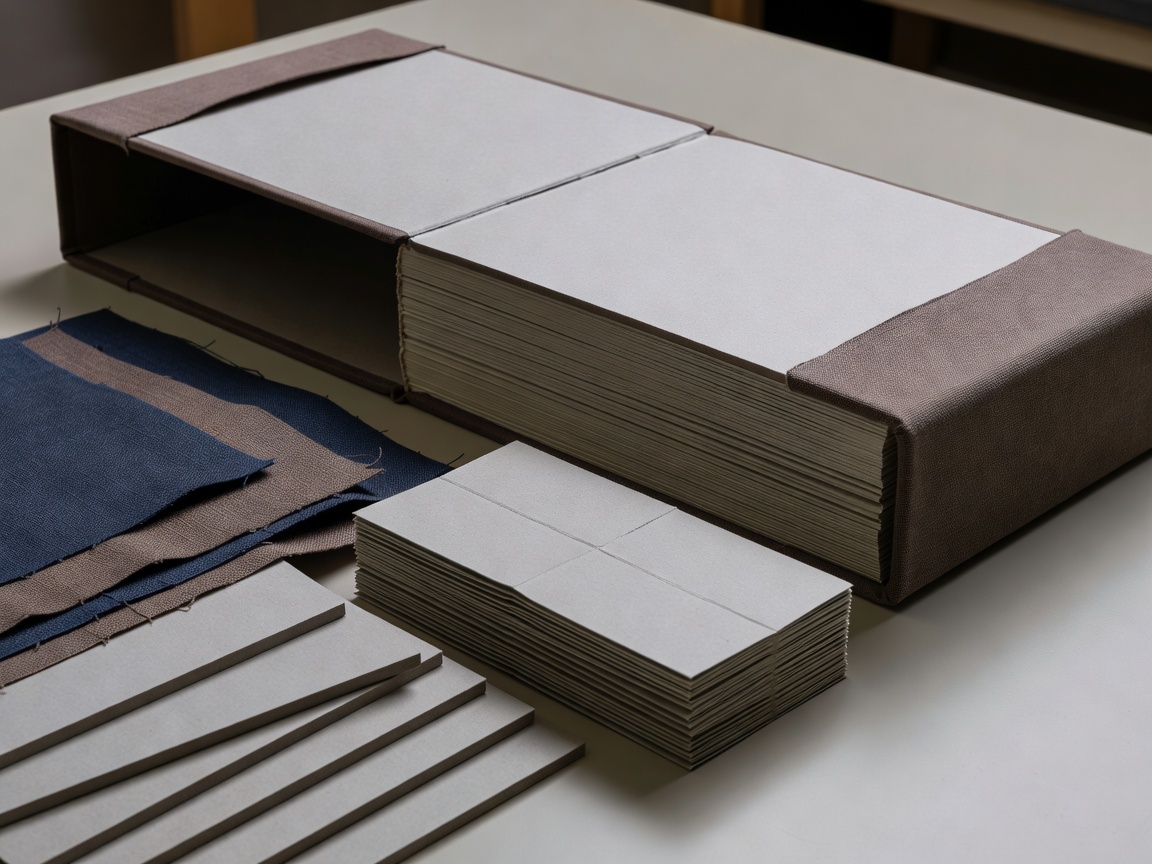
1. Start with the text block
The text block is the stack of pages that becomes the inside of the book. In traditional section sewing, sheets are folded into gatherings, also called signatures, and sewn through the fold. The grain of every sheet should run parallel to the spine. If the grain runs across the spine, the pages resist opening and the whole book feels strained.
For a first case binding, use a moderate number of sections rather than one thick stack. Thin sections fold more cleanly and make swell easier to control. Swell is the extra thickness created by thread in the spine folds. Too much swell makes the spine bulge; too little attachment can make the book weak.
2. Add endpapers before the cover appears
Endpapers are folded sheets that connect the text block to the boards. One leaf is pasted to the board later, and the other becomes the first free page inside the cover. They look decorative, but their job is structural. Use paper strong enough to act as a hinge, with grain parallel to the spine.
Tip the endpaper on carefully if the structure calls for it. Tipping means applying a narrow line of adhesive near the fold or edge, not flooding the sheet. Excess adhesive makes the first and last pages cockle before the cover has even been made.
3. Line the spine with purpose
After sewing, the spine is often glued and lined. Polyvinyl acetate, usually called PVA, is common because it grips quickly and dries flexible when used thinly. Wheat starch paste dries more slowly and is easier to reverse with moisture, but it needs patient handling. Many beginners use a mix or choose one according to the book’s use.
Mull, also called crash, is an open-weave cloth added over the glued spine. It extends onto the endpapers and helps transfer pull from the text block into the cover. Paper linings can then smooth the spine. Do not build a stiff ridge unless you want a stiff book.
4. Make the case accurately
The case is the cover made from two boards, a spine piece and covering material such as book cloth or strong paper. The boards should be larger than the text block by an even square. The square is the small visible overhang around the pages. Its exact size depends on the book, but it must be consistent at head, tail and fore edge.
Leave hinge gaps between the boards and the spine piece. A hinge gap gives the cover room to open. If the boards sit too close to the spine piece, the cloth cannot fold neatly and the book will fight the reader. If the gap is too wide, the cover feels loose and unsupported.
5. Case in with less glue than instinct suggests
- Dry-fit the text block into the case and check the squares.
- Place waste paper under the first pastedown, the leaf that will be glued to the board.
- Brush adhesive from the centre outwards, keeping the coat even and thin.
- Close the board onto the pastedown rather than sliding the wet paper around.
- Repeat on the other side, then press the book between clean boards.
The book should dry under weight, but not under brutal pressure. Too much pressure can force adhesive into the hinge and make the cover stiff. Change blotting paper if moisture remains. Open the book gently only after the adhesive has set enough to keep the pastedowns flat.
Common trade-offs
A square-back case is simpler than a rounded and backed spine. Rounding and backing can improve the look and opening of thicker sewn books, but it adds tools and judgement. For a first hardback, square-back construction teaches alignment without adding a second craft at the same time.
Book cloth is easier than decorative paper because it resists tearing at the corners and hinges. Decorative paper can work well when strengthened or paired with cloth at the spine. If you use paper, test how it reacts to moisture before covering the actual boards. A beautiful sheet that stretches unpredictably is not being difficult; it is doing what paper does.