Paper moves first. Adhesive follows.
Paper grain is the direction in which most fibres align during manufacture. Adhesive adds moisture, pull and stiffness. Good bookbinding starts by predicting how those two facts will meet.
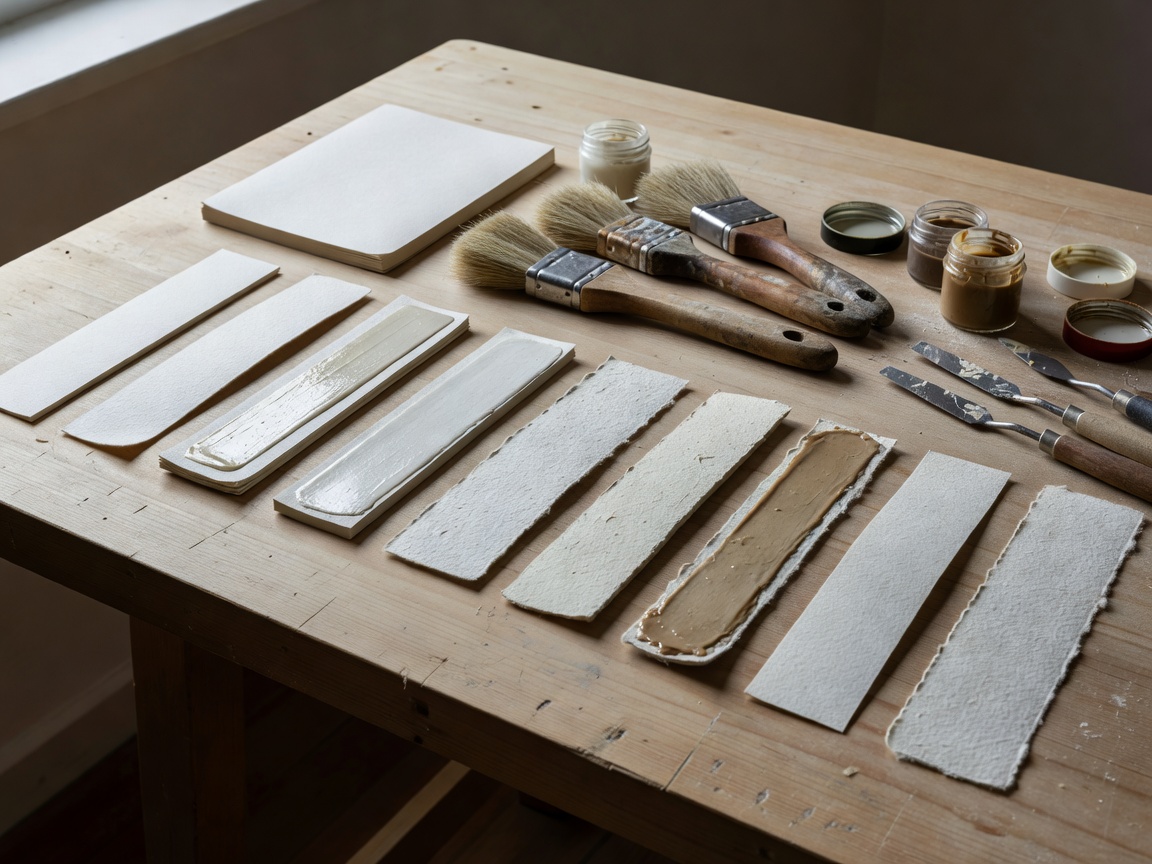
1. Find the grain
Use more than one test when possible. First, bend the sheet gently one way and then the other. The easier bend usually follows the grain. Second, tear a narrow strip in each direction; the tear often runs straighter with the grain. Third, dampen one side of a small offcut and watch the curl. These tests are imperfect, but together they give useful evidence.
For books, grain should usually run parallel to the spine. Folded sections open more easily, boards warp less aggressively, and pastedown papers pull in a more predictable direction. Cross-grain work may be possible in small decorative pieces, but it asks the structure to compensate for the material.
2. Match adhesive to task
PVA, short for polyvinyl acetate, is widely used in modern bookbinding and paper craft. It is convenient, strong and quick-grabbing. Use it thinly. A thick layer dries slower, adds ridges and can make hinges stiff.
Wheat starch paste is made by cooking starch with water. It has a long open time, which means you have more time to position paper before it grabs. It is valued in conservation because it can be easier to reverse with moisture than many synthetic adhesives. It is not instant, and it must be prepared cleanly.
Methylcellulose is a cellulose-based adhesive that mixes with water to form a clear gel. It has a long working time and can be used alone for light work or mixed with paste or PVA to alter handling. Glue sticks are convenient for mock-ups and light paper projects, but many are poor choices for structural book work because coverage is uneven and the bond can be weak.
3. Read moisture as a design constraint
Water-based adhesives swell paper fibres. One wet side expands, then contracts as it dries. That is why a pasted sheet curls. The answer is not always more pressure. It is usually better grain direction, thinner adhesive, balanced moisture and suitable drying boards.
- Test the adhesive on the same paper, not on a convenient scrap of different stock.
- Brush from the centre outwards to spread moisture evenly.
- Use waste paper under edges so glue does not mark the bench.
- Replace wet waste paper before closing a book or pressing a sheet.
- Dry between clean absorbent sheets and flat boards when flatness matters.
4. Compare common adhesives
| Adhesive | Useful for | Main trade-off |
|---|---|---|
| PVA | Spine gluing, case making, board covering | Fast grab leaves little repositioning time |
| Wheat starch paste | Pasting paper, repair-style work, slower positioning | Needs preparation and longer drying |
| Methylcellulose | Light paper work, slowing blends, clean handling | Not always strong enough alone |
| Glue stick | Temporary mock-ups and very light craft | Uneven bond and limited strength |
5. Avoid the usual faults
Cockling is the wavy distortion caused by moisture and drying tension. It often appears when adhesive is uneven or the paper is too light for the task. Warping happens when one side of a board receives moisture and the other side does not balance it. In case binding, pastedowns can pull boards if grain, glue and drying are poorly matched.
Staining can appear with thin or absorbent papers. Test first, especially with coloured or handmade sheets. Some papers darken when wet and recover as they dry; others keep a tide mark. No label on the adhesive jar can predict every paper surface.
Practical selection
For a first hardback, PVA is manageable if used sparingly and paired with careful pressing. For decorative paper over boards, paste gives more time and less panic. For Coptic stitch, adhesive may be limited to covering boards because the spine is sewn. For Japanese stab binding, avoid stiffening the hinge margin unless the design needs it.